Saturday, 5 April 2014

The three chicks hatched today
I love being a bird ringer, someone who safely catches birds and puts identification rings on their legs so we can follow them later in life. It gives you the chance to really see birds up close and have an intimate insight into their lives. 

As part of becoming a ringer I have also had the privilege of ringing babies birds in their nests. And in recent years I have got more into this, especially as the British Trust for Ornithology has been promoting us to look out for nests and record the number of eggs and chicks. This is providing a better picture of how well our common (and less common) birds are doing in terms of having eggs and babies. 

The four beautiful eggs a week ago
Over the past week I have been following a nest of dunnock eggs in my garden. I suspected they were nesting and a little searching revealed a nest with four beautiful bright blue eggs. This morning I checked on the nest to find three tiny babies and a single egg. Incredible! I think they have only just hatched and over the next week I will follow their development. 

It is wonderful to see baby birds up so close in the wild. They grow so quickly and I hope to be able to ring them in a week's time. If they get found alive (or dead) we will know how old they are and where they came from. 

Wednesday, 19 March 2014

Seadragon bones found while fossil hunting with school

The two seadragon or Ichthyosaur
bones are top  right in the photo.
I took a Bristol school fossil hunting yesterday. In ten years of doing these trips, I have seen the backbones of seadragons or Ichthyosaurs (http://www.bbc.co.uk/nature/life/Ichthyosaur) found only twice before (once by a teacher).

Yesterday, I found one while talking to one of the teachers (it was just there by my foot!), and then one of the girls suddenly showed me a fossil - it was another backbone of an Ichthyosaur! These sea-faring reptiles lived around Bristol 200 million years ago and lived in the warm, tropical seas that existed back then.


The backbone found by the pupil
They are rare to find here so something to shout about. Along with these the children found lots of different shelly fossils (oysters, spiky cockle-like shells, curly whirly shells), fossilised poo (coprolites), and tiny teeth from ancient fishes. 

Thursday, 29 November 2012

Great Northern Diver

When an unusual bird turns up in Bristol, it may have overshot its destination, or been blown over by strong winds. Sometimes, the bird is simply ill, or unable to find suitable food, especially if it turns up in the muddy Severn Estuary!

Recently, a very tame Great Northern Diver was found feeding close to people on a marine lake at Weston Super Mare - aside from providing some amazing opportunities for photos, the bird was also seen feeding on crabs. 

Sadly, after a week or so of being here, it was found dead today by ecologist Phil Quinn - I happened to bump into him outside the Bristol City Museum as I was on my way back to my office. He had the diver with him, and was about to take it into the museum. 

Removing the bird from a black, plastic bag on the path outside Browns restaurant (as you do!), I marvelled at this large, duck-sized bird which had flown down from Iceland or Canada. It was clearly a juvenile, with immaculate plumage, and silvery, shimmery edges to its back, and shoulder feathers. As with all divers, the legs were flattened; ideal for moving through the water with the least resistance. As we looked closer at its huge, thick bill, we noticed the nostril was divided in to two parts, perhaps an adaptation to help with diving. 

While it is sad the bird died, at least it can now contribute further to science - over time it will be mounted and used as part of the local, museum collection at Bristol Museum & Art Gallery.

For photos of the bird alive, see the avonbirding blog

Monday, 16 April 2012

A thrilling wildlife moment - redstart

I had one of those truly thrilling wildlife moments yesterday - it's very personal and relates to redstarts, a relative of the robin which have just arrived in the UK from West Africa. They are stunning birds and at Portbury Wharf Nature Reserve I had the chance to hold and ring a beautiful male. Some people may opt for a bird of prey or a colourful parrot as their ultimate bird to see up close, but for me, seeing this beauty in the hand was just so exciting!


After missing out on a deluge of migrants dropping in to the reserve on Saturday morning I was determined to be at the ringing site on Sunday morning after leading a dawn chorus cycle ride in Bristol's Avon Gorge. There were less migrants around but from our ringing site we were watching a female and the odd male redstart fly-catching in the nearby scrub. 


Towards the end of the ringing session, around lunchtime, I went to check some nets for the last time and suddenly spotted a male redstart on the grass. It flew away from me and flew straight into the pocket of one of our mist nets! Eureka! I ran over to the net, safely removed the bird and brought it back for ringing. 


And here it is!


I've been wanting to see one up close for years - I used to spot redstarts at Thursley Common in Surrey when I was a teenager and have since seen them in the Forest of Dean and different parts of Wales. 
However, their black mask, white forehead and rusty-red tail have fascinated me - a truly flashy bird. 


What's even more remarkable is that these birds have been wintering in the scrubby woodland in parts of West Africa - countries such as Guinea, Ghana and Ivory Coast. In recent weeks they have been flying across Africa, into Spain, France and in recent days have arrived en masse in the UK. And they've been everywhere, heading to mature oak woodlands, heathland and pasture, particularly in the west of Britain. 


Let's hope he makes it to his woodland territory and gets spotted by another ringer or birder!

Saturday, 31 December 2011

Young Peregrine travels from Avon Gorge to the West Midlands


I've been colour-ringing peregrine chicks since 2007 with the help of fellow BTO ringer Ade George, and volunteer climbers from the British Mountaineering Council. In each year I have been building up the number of nest sites we visit to maximise how many chicks we ring. With bird ringing (or banding) it is a numbers game - the more birds you ring, the more likely someone will spot one of 'your' birds and report it. With colour-ringed birds this likelihood increases hugely - while only perhaps 2% of birds with just metal ID rings may be resighted, up to 98% of birds colour-ringed may be recovered.


BX - one of five chicks ringed in the Avon Gorge in 2010. Photo by Ed Drewitt.
With my peregrine work the results can be a little delayed. In the first first few years a peregrine's life is very nomadic as it travels around getting to know the region and no doubt look for a mate. So it's not until a peregrine begins to settle at a nest site at two or three years old that it may be seen and identified by birders.


Of my peregrines that have been re-sighted so far, most have been quite close to Bath and Bristol, near where we ringed them. For example, one was seen with a female partner 15km south of Bristol from where it was ringed two years later; another is now the breeding male at a nest in Bath where it hatched; and a third individual was re-seen later in the autumn at the site where it was ringed and had fledged earlier that year.


Our furthest travelled bird however goes to the following individual. One of the young peregrines we ringed in the Avon Gorge in 2010 was also filmed for the BBC's Springwatch.
He was given a blue colour-ring with black letters, BT (his sibling BX is in the photo above)


He was spotted and photographed by Michael Colquhoun in the Malvern Hills, Worcestershire back in April 2011. This was exciting news and it was great to know one of the chicks had ventured so far. 

BT in April, 2011 - now is partial adult plumage in the Malvern Hills. Photo by Michael Colquhoun
BT's colour ring clearly visible. Photo by Michael Colquhoun.
However, I then had sad news in October 2011 that a peregrine with one of my colour-rings had been found dead by a dog walker not far from KIdderminster in the West Midlands. After exchanging e-mails with local birder Jason Kernohan who met the dog walker and recovered the dead bird, I discovered it was the same colour-ringed individual, BT. 


He had been dead for four days before being found (as indicated by the development of moaggots). He was taken to a vet by the police for an x-ray to confirm he hadn't been shot. He had been found below power lines and seems likely he had died from some interaction with these. 

BT's colour ring. Photo by Jason Kernohan
BT's metal BTO ring. Photo by Jason Kernohan.

Despite this young bird's death I'm pleased we know his final outcome and where he travelled. It helps build up a bigger picture of what peregrines do when they fledge. It's interesting that we've not heard from the other four chicks that were in that same family. Yet we have heard from this individual twice! Hopefully as the other four (assuming they are all alive) begin breeding they will be spotted and identified by myself or someone else watching them.


Tuesday, 6 December 2011

A murmuration of Starlings close to home

Here's the sounds of thousands of starlings at roost!


And here's my own running commentary of the same experience close to my home:


There's been a lot of publicity recently on the incredible starling experiences across the UK where millions of these gregarious birds form swirling shapes movements, moving through the sky as a single entity like a squidgy, amoeba changing form and size every second! It leaves those watching it for real or viewers online or watching tv with mouths wide-open, in awe at the sheer complexity, beauty and form. 

Here in Bristol, one of the most well known starling experiences is about an hour away down on the Somerset Levels. Millions on starlings roost in the reedbeds, feeding by day on the farmland across Somerset. Even more mind-boggling is that huge numbers of these birds originate from Russia and eastern Europe which is currently very much colder and frozen compared to the west of England (where it's just wet and mild!).

In the past few weeks thousands of starlings have been performing this incredible display close the second Severn Crossing on the Severn Estuary near Bristol. It's only ten minutes drive from my home and an awesome opportunity to watch such a spectacle so close by. They were swirling round above my head and so close I could even smell their compost-like scent! And once the mass drop down in the bushes, they break their silence and burst out into a cacophony of squeals, whistles and gurgles as they squabble over their roosting space!at

I captured (above) this murmuration of starlings on the Somerset Levels in February 2010.


Colour-ringingd Robins - alas, halted by the British weather again!

The British weather - a phenomenon we always seem to be talking about and something where there is genuinely (arguably!) always something to be chatting about! And this morning is of no exception. Helping a Masters student at the University of Bristol with a project on robins we were all set for catching and ringing a few more this morning - but then at 4.30 this morning the rain was beating against my bedroom window and the wind speed had turned from calm (and clear starry skies) to gale force! Time to cancel and re-arrange - again!

The project itself involves carefully catching the robins in  a mist net, putting special colour rings that denote each individual on their legs plus a metal ring issued by the British Trust for Ornithology. Our red-breasted friends are then measured, aged and weighed before being released.

Dan, whose Masters project this is, is looking at the alarm calls of the robins and how the individuals
interact with each other - hopefully over the next few weeks before Christmas we'll be able to ring a few more to help Dan know who is who.

Below is a photo of one of the colour-ringed robins - I'm especially interested to see whether any of the robins disappear (perhaps as migrants) and who stays around or the spring to breed.


Tuesday, 3 May 2011

seabirds galore at Severn Beach

Last night was a most astonishing and special experience at Severn Beach, on the Severn Estuary. With
persistent north-easterlies, a rising tide and sunshine in the evening it was perfect conditions for seabird watching.

Flocks of dunlin and ringed plovers busily fed, scattered along the tide line before the water covered any available food. The ringed plovers rested further up the foreshore on the shingle.

Meanwhile, a flock of  over one hundred bar-tailed godwits moved around the coastline, often appearing just in front of me, hanging in the wind with bowed wings. When they landed, the brick-red adults stood out from those still in their grey-brown winter plumage. I never seen this many here before1

Suddenly above the sea, a large swirling flock of a few hundred terns, moved across the sky before drifting further west after they reached the M4 Severn Bridge. A little later, an even larger flock of over five hundred birds stretched low across the water. As they edged closer they gained height, their elongated bodies and angled wings keeping them together as the wind blew them back. Many funnelled down to rest briefly with the roosting bar-tailed godwits before rising again to join the main flock. At the front of the flock a black tern stood out with it's dark, black belly. The flock flew right across the sky hanging on the edge of the estuary over the beach - at one point hundreds hung in the air above me, calling away. Wow! Just amazing!
They moved towards the bridge before drifting west, getting higher and high as they went. They didn't seem to be getting very far!

Meanwhile, hundreds more bar-tailed godwits had appeared - the roosting flock had also been disturbed by dog walkers. A large flock of a few hundred flew overhead and moved in land, calling. Another flock came close overhead - wow! They rested near the dunlin and ringed plovers giving incredible views.

Whimbrels 'bubbled' overhead, again giving wonderful views in the evening sunshine. A grey plover flew singly over the water. Meanwhile, far across the estuary the odd darker gull gliding up and down, using the waves for lift may well have been an Arctic skua or two.

It's incredible to think that just three or four days previous the bar-tailed godwits would have been on the coast of the Gambia or Senegal. They fly almost direct back to their breeding grounds - indeed, the birds I saw weren't stopping for long. I wonder what journey the terns have made? - most were probably Arctic terns having followed the African coast up past Portugal, France and then over the Channel.

What will this evening will have in store?!


Saturday, 12 February 2011

First reed bunting I've ringed to be spotted elsewhere!

Yay! Information on the first control of a bird I ringed which has then been found somewhere else has just come in!

A reed bunting I ringed on 17th October 2009 turned up at Corsham Lake in Wiltshire, 
37 km away on the 19th November 2010, 398 days later!! Here's a photo of possibly the same bird (I ringed half a dozen reed buntings that day - passing through on migration). 

One was also a control (ie already ringed) from further up the road in the Gordano Valley. Not bad for one morning's ringing of 15 various birds in total!!

Sunday, 6 February 2011

Cranes, bitterns and swans: Tour leading on the Somerset Levels

It's a bit of cliche saying every day is different, but this week couldn't be more true.
At the beginning of the week is was freezing (again!) and I was doing a few dinosaur workshops before finishing paperwork in the office on Tuesday.

Cranes in flight
Tuesday evening, Wednesday and Thursday I was tour leading for Naturetrek on the Somerset Levels. Myself and Charles Martin took sixteen clients down to the Levels to experience this unique habitat and see some great wildlife. We weren't disappointed, especially as the temperature had risen well above freezing and most stretches of water were ice free. Highlights included seeing sixteen cranes (as part of the Great Crane project), thousands of wigeon, one hundred pintail, Bewick's swan and brief glimpses of bitterns! We also watched seven roe deer in a ploughed field and a fox quartering the field where the Bewick's swans were feeding, perhaps with high expectations of catching one! The starlings showed in their millions (although they decided to roost on Shapwick instead of Ham Wall), while six bright great white egrets fed in the reeds at Ham Wall. We were staying in the wonderful surroundings of the Swan Hotel in Wells with Wells Cathedral in view from the bar. Brilliant food and service as always.


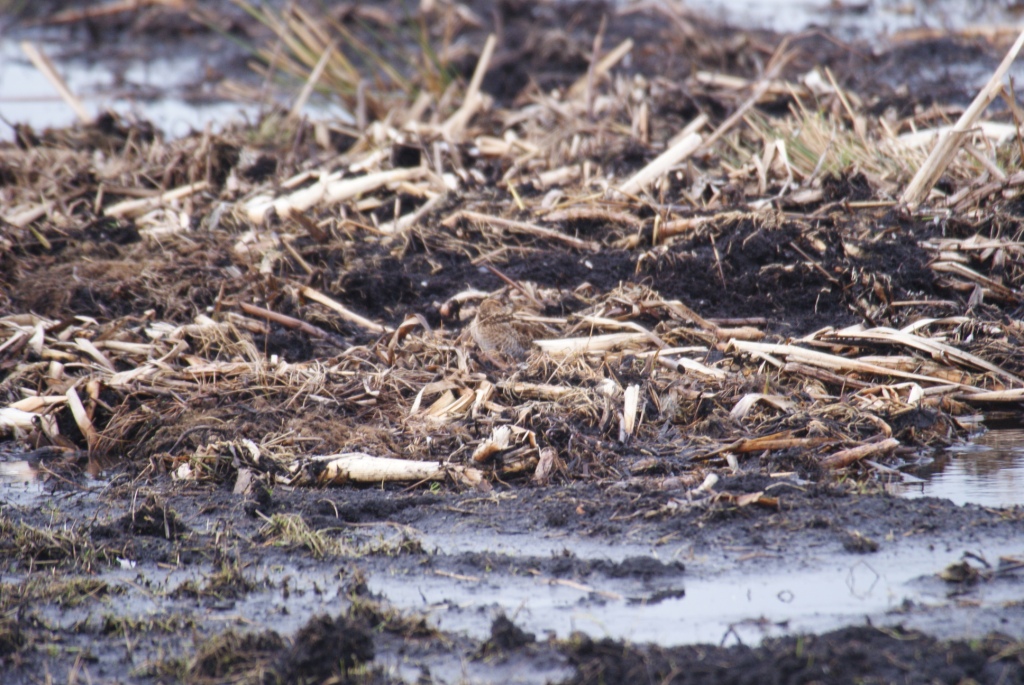
Can you  spot the snipe?

I was then back to the university on Friday catching up on e-mails, giving a dinosaur workshop to nursery children in Knowle West and various meetings in the afternoon.

Yesterday I paid a visit to Slimbridge WWT to help a friend film a showreel - we got there early and made our way to Puddleduck Corner where the ducks and geese were just having their morning feed. It was fun (and noisy) being surrounded by lots of red-breasted geese, Hawaiian geese and bar-headed geese! On our way, the otters must have been hungry as all four were fidgety and coming very close while nuzzling each other on the other side of the glass.

I'd never realised just how big Rouen ducks were - at Puddleduck Corner they have a collection of different types of domestic ducks such as Khaki Campbells, call ducks, runner ducks and Rouen ducks. The huge, long, breast bone of the latter made them look incredibly mis-shaped and awkward - a feature bred to produce lots of meat no doubt.

The filming went well and as we finished a small flock of siskins flew into the nearby alders.
Meanwhile, from the Rushy Pen we could see the two wild scaup snoozing, Bewick's swans were trumpeting, and as we left  a few hundred wild white-fronted geese flew overhead!

Monday, 31 January 2011

Packing for my next wildlife tour

I had a lovely morning doing a Bristol dinosaur workshop at a private school today - normally I'm in Bristol City Council schools so it was very interesting working with year 3s from this school. Incredibly bright and I was able to ask more challenging questions than I normally would. It was a cold morning, minus 2 degrees Celsius and on my way back to work I checked on the berry bushes in Henleaze for any waxwings - sadly none were there!

While topping up my bird feeder this morning some redwings were calling in the nearby trees - hopefully they nipped down to peck on the apples I'd just put out (before the jackdaws flew away with them!!!). Sadly the sunshine which graced Bristol over the weekend was not to be today. Yesterday I had a glorious afternoon at Bristol Zoo with Andy - all the animals seemed bright and energised (or may be that was just me!).

This evening I've been packing ready for some tour leading with Naturetrek on the Somerset Levels and then nipped off to the Bristol Ornithological Club's committee meeting. I'm looking forward to the nature tour beginning tomorrow evening in Wells - especially as the great white egrets and starlings have been showing so well. I'd better not speak too soon!!

Sunday, 30 January 2011

The Big Garden Birdwatch

Yesterday I did the Big Garden Birdwatch with a friend Liz - we spent an hour 2.15pm to 3.15pm looking out of my flat window while chatting, enjoying tea and cookies!!! As expected, some birds I've seen recently such as coal tits and dunnocks didn't make an appearance. However, over the hour we finally concluded that at least 9 chaffinches were feeding on the lawn (they were a bit jittery and kept flying back into the trees!) while at least 2 great tits and 2 blue tits fed on the feeder. A few jackdaws came down to pinch some old sandwich I had put out and although there were no starlings in the garden a few small flocks did fly by! 2 male and 2 female blackbirds fed on the apples and half an hour after the Big Garden Birdwatch 2 mistle thrushes sat in a sycamore tree!

If you haven't done it yet, there's still time today - just spend an hour watching your garden or local park and record the maximum number of each type of bird you see. Then submit the sightings to www.rspb.org.uk/birdwatch.

And yes, the following day the dunnocks did reappear, singing with full vigour!

Full totals:

Blackbird 4
Blue tit 2
Chaffinch 9
Great tit 2
Magpie 2
Robin 1
Woodpigeon 2
Jackdaw 4
Carrion crow 2

Friday, 28 January 2011

Radio Bristol and the Big Garden Birdwatch

The past few days I've been busy helping to promote the RSPB's Big Garden Birdwatch, www.rspb.org.uk/birdwatch on BBC Radio Bristol! Listen out for me also on the weekend - I'll be Doctor in House with Faye Dicker on Saturday 10-11am talking about what we can do for nature this spring while on the very early morning show I'll be chatting with Nancy Jackson about counting birds!

Today I'm in a school in Cheddar, Somerset. Very cold but at a great school! In between giving dinosaur workshops I'm watching the redwings just outside the classroom feeding on plenty of worms on the grass!
A few siskins flew overhead earlier.  

Saturday, 22 January 2011

Ringing ducks in Devon!

An awesome day ringing ducks with the Axe Estuary Ringing Group today! At 7.30am we gathered for a briefing before waiting for the ducks to begin feeding on the grain. Bang! The cannons fired and that was our queue to run to the nets to bag the ducks. Shelducks, wigeon, shoveler, teal, mallard.....it was looking like a good catch! Everyone worked together as a team and by late morning we'd ringed and processed just under 60 ducks including 8 shovelers and 3 wigeon. It was a great opportunity to be part of the team and really get to grips with the shelducks as well as the other species. The shelducks were also being colour ringed with bright yellow ID leg rings.


Thursday, 23 December 2010

Waxwings!

A real treat today - as I was writing an e-mail I spotted a starling-sized bird with a crest in the sycamore tree. I instantly knew it was a waxwing. It swooped down out of view and I later realised there's a shrub full of rose-hips where it must have been feeding! What an awesome garden tick! Combined with a male brambling yesterday and all five species of winter thrush this week I'm not doing too badly!

While at the recycling place at Avonmouth there were hundreds of black-headed gulls, herring gulls and the odd lesser black-backed gull flocking around the waste warehouses! No doubt cashing in on good grub being delivered throughout the day. Along the road pied wagtails and dunnocks were feeding in the slush - no doubt goodies coming off the rubbish trucks' tyres!

On my way home I spotted some starling-like birds and could see they were waxwings too - just a few, but waxwings nonetheless! And once at home some black-headed gulls and herring gulls were flying low over the neighbourhood on their way to roost.

Everywhere you look there really is something to see - I'm going to miss it all while I'm a away for a few days for Christmas! Have a trusty neighbour to feed the garden birds for me though!

Tuesday, 7 December 2010

Waxwings, common gulls and winter wonderland

After a morning resting fighting off a cold I set off for work - it still hadn't risen above minus 4.5 degrees Celsius.

The garden had been busy this morning - I threw out the leftovers of a chicken carcass and attracted a dozen black-headed gulls, a few herring gulls and....a rarity in Bristol, a common gull. Despite being common in urban areas in the south-east they stick to the hills in the west.

I went to work via Avonmouth hoping to spot some waxwings that had been seen yesterday. I wasn't disappointed - 7 were resting and feeding on some snow covered berries and I got some lovely views. A few fieldfares were having their share too. The odd lapwing flew overhead.


The trees everywhere were covered in harsh frost and even snow around Avonmouth. The Downs in Bristol looked stunning.

To help get us all in the Christmas spirit we had a carol service in the Great Hall of the Wills Memorial Building at lunch time - wonderful. And then battling in a freezing cold office I left a little early to continue getting over my cold and reminisce on the waxwings!

Thursday, 2 December 2010

The Big Freeze

Wow! Seems a long time since I last made a post. It's been a busy three months with the Bristol Dinosaur Project, leading bird identification courses and various appearances on tv and local radio!
Despite the big freeze across the UK we seemed to have come off pretty lightly in Bristol receiving only a light dusting. It's still incredibly cold outside though, not rising much above freezing. I've been putting some apples out in the garden which have been welcomed by the blackbirds. I spotted a male blackcap today too, a visitor from Germany while a mistle thrush was cocking its tail and getting a good view of the neighbourhood on top of the sycamore tree outside my flat. Yesterday I spotted 30 lapwings flying south across Henbury, no doubt escaping the snow further north. Be interesting to see how the next few days pan out - it should be getting a little warmer.

Wednesday, 21 July 2010

The Centennial Egg - a piece I did for Miles Barton, producer for the BBC Natural History Unit

Filming for the One Show

I've just been filming with presenter Miranda Kestovnikoff for the One Show talking about about eagle owls and in particular Oscar the eagle owl, who became a star in this part of Bristol. Oscar was living in the wild around Biological Sciences and while we can't rule out him coming from captivity, it is possible he was a truly wild bird.

Tuesday, 20 July 2010

Reporting on cirl buntings for Radio 4's Saving Species

Yesterday I was reporting on cirl buntings for Radio 4's Saving Species, interviewing the RSPB about their current translocation programme where they are moving young birds from Devon to Cornwall. The show is repeated this Thursday at 9pm and can be heard on bbc iPlayer at this link:
http://www.bbc.co.uk/programmes/b00t1xt1